
“You’re just not trying hard enough.”
Many adults hear some version of this before they ever get assessed. Some hear it from teachers. Some hear it from family. Some hear it from themselves, for years, before anyone mentions ADHD. An ADHD assessment Australia pathway often starts long after these comments begin.
This is not a personal failing. It is a gap in access.
Getting an ADHD assessment in Australia involves a defined process. It is not always fast, and it is not always simple, but it is predictable once you know the steps.
This guide sets out exactly what that process looks like, from the first phone call to your GP through to a formal diagnosis and treatment plan.
Step 1: Start with your GP
The pathway almost always begins with a GP visit.
Your GP will ask about your symptoms, your history, and how your concerns are affecting daily life. This might cover work, study, relationships or parenting.
If ADHD seems likely, your GP will refer you to a psychiatrist or paediatrician for a formal assessment. A GP cannot diagnose ADHD on their own. A referral is a required step, not an optional extra.
Step 2: Get your referral sorted
A valid referral is needed before a specialist assessment can go ahead.
For adults, this means a referral to a psychiatrist. For children and young people, it is usually a referral to a paediatrician with mental health training.
Some clinics, including ours, can guide you through what the referral needs to include so there are no delays once it reaches us.
Step 3: Complete background forms and questionnaires
Before your appointment, you will usually be asked to fill in background forms.
These cover your developmental history, your current symptoms, and how they show up across different parts of your life. Some clinics also request input from a parent, partner or close contact, since ADHD symptoms are often easier for others to notice than for the person living with them.
Pathology referrals or blood tests may also be requested. This is a routine part of ruling out other explanations for your symptoms before confirming a diagnosis.
None of this is designed to catch you out. It exists to build an accurate picture.
Step 4: Attend your psychiatric assessment
This is the core of the process: a structured psychiatric assessment with a specialist.
At Bondi ADHD Centre, this assessment happens by video consultation. You do not need to travel to Bondi, or anywhere else, to be seen by a psychiatrist or mental health paediatrician.
Telehealth ADHD diagnosis works the same way an in-person assessment does. The clinician reviews your history, discusses your symptoms in detail, and considers other conditions that can look similar to ADHD, including anxiety and depression.
For many adults in regional or remote areas, telepsychiatry is the only realistic way to see a specialist without a long wait or a long drive.
Step 5: Receive your diagnosis and a plan
At the end of the assessment, you will be given a clear outcome.
If ADHD is confirmed, your psychiatrist will discuss treatment options, which may include medication, behavioural strategies, or both. If medication is appropriate, ongoing ADHD medication management is arranged through follow up appointments, also delivered by telehealth.
If ADHD is not confirmed, you should still receive an explanation of what was found and a referral for anything else that needs attention. A thorough psychiatric assessment often uncovers more than one thing worth addressing.
What this looks like for children
The pathway for a child ADHD assessment in Australia follows the same broad structure, with one key difference: information is gathered from parents, carers and sometimes teachers, not only from the child.
A mental health paediatrician will ask about developmental milestones, behaviour at home, and behaviour at school. Reports from teachers can support the process but are not always required to proceed.
Parents often come to us after months of being told to “wait and see.” An assessment gives families an actual answer, rather than more waiting.
Beyond ADHD
ADHD rarely exists in isolation. Anxiety, depression, and autism spectrum traits frequently appear alongside it, and sometimes explain symptoms that look like ADHD but are not.
Because of this, a proper assessment also screens for other conditions. At Bondi ADHD Centre, this includes assessments for ASD, anxiety, depression, binge eating and addiction, alongside general psychiatric evaluation. One consultation can address more than one concern.
Where telehealth fits in
An online psychiatric assessment in Australia removes several practical barriers at once: travel time, limited specialist availability in your area, and long gaps between appointments caused by local shortages.
A free national ADHD helpline also exists through Medicare Mental Health, offering guidance on the pathway to diagnosis for anyone who is still working out where to start. It will not provide a diagnosis, but it can point you toward the right next step.
Specialist wait times vary by clinic and by state. At My ADHD Centre Bondi we make sure you will get an appointment within 1-3 weeks and current assessment fee and any rebate amount should be confirmed directly with our team before booking, so you know exactly what to expect.
An ADHD assessment Australia process you can actually follow
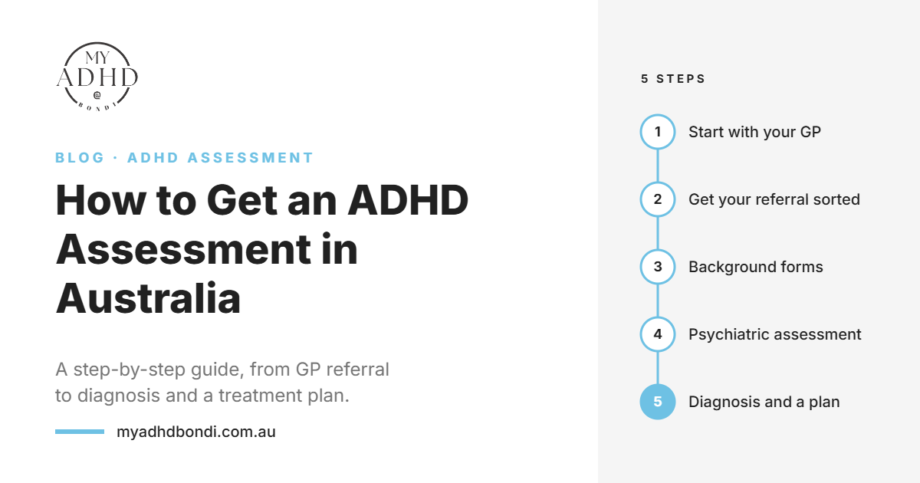
The steps are straightforward: GP visit, referral, background forms, specialist assessment, diagnosis and plan.
What is not straightforward is the waiting many people endure before they take the first step. Some have carried unexplained symptoms for years. Some were told their struggles were a character flaw, not a neurodevelopmental disorder.
An ADHD assessment in Australia will not undo that time. It can, however, give you language for what has been happening, and a specialist’s plan for what happens next.
Have you been putting off an ADHD assessment because the process seemed too complicated to start?
#ADHDAssessmentAustralia #TelehealthADHD #ADHDDiagnosis #OnlinePsychiatricAssessment #ADHDClinicBondi